Session 4: Examples & References
Behaviour & Agency
A system begins to feel like it has behaviour when its actions depend on its current state, its environment or the actions of other elements.
The rules can be extremely simple.
While looking through these examples, ask:
- What is the smallest behaving element?
- What information does it have?
- What can it sense?
- What causes it to change direction or state?
- Is the behaviour deterministic or probabilistic?
- Does it interact with other elements?
- Does it remember anything?
- Is there feedback?
- What larger behaviour emerges from the local rules?
- When do we begin to describe a system as if it has intention or character?
Generative Design P_2_2: agents, paths and systems
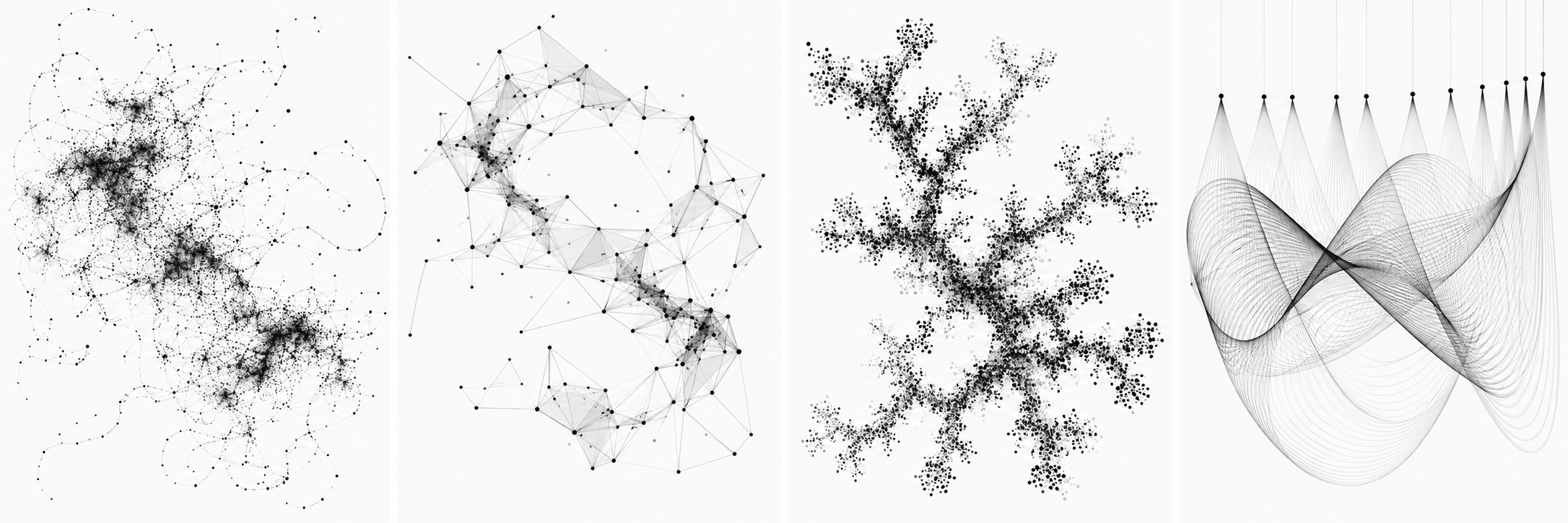
Selected P_2_2 examples from Generative Design.
The P_2_2 section of Generative Design / Generative Gestaltung is one of the most useful practical references for this session.
Instead of concentrating on grids and static variation, these examples introduce elements that move, respond, accumulate and interact.
The series progresses through several different ideas.
P_2_2_1: a simple wandering agent
The first examples describe what the code itself calls a “stupid agent”.
The agent has:
- a position
- a step size
- several possible directions
- a rule for choosing the next direction
The resulting drawing is not designed line by line.
It is the history of the agent’s movement.
P_2_2_2: more directed behaviour
The next examples introduce additional logic.
Movement can depend on:
- direction
- boundaries
- angles
- the current position
- previous decisions
The agent still follows relatively simple rules, but its behaviour becomes more structured.
P_2_2_3: connected agents
Several points change independently but remain connected as one form.
The individual movements are simple, while their relationship produces an evolving larger shape.
This introduces an important idea:
An element can have its own behaviour while still belonging to a larger system.
P_2_2_4: diffusion aggregation
New elements are placed according to their relationship with elements that already exist.
A global branching structure gradually emerges from many local proximity decisions.
The final form is not drawn in advance.
P_2_2_5: circle packing
New circles are added wherever space is available without overlapping existing circles.
The system gradually fills the available area.
Here the environment itself changes as the system develops.
Each new circle changes what is possible for the next one.
P_2_2_6: linked pendulums and traces
Several linked oscillating elements move at related speeds and lengths.
Their movement produces paths over time.
The final image is a trace of the system’s behaviour.
Look for
Across the P_2_2 series, identify:
- position
- direction
- velocity
- current state
- constraints
- boundaries
- randomness
- relationships between elements
- traces
- feedback
Do not only look at the final images.
Open the code and ask:
Which rule is responsible for which behaviour?
Try this
Choose one P_2_2 example.
Before changing anything, identify:
- What is the agent or active element?
- What state does it store?
- What changes every frame?
- What conditions affect its behaviour?
- Where does randomness enter?
- What produces the visible trace?
Then change one behavioural relationship rather than redesigning the whole program.
For example:
Keep the movement, but change the boundary response.
Or:
Keep the agent, but change when it leaves a mark.
Or:
Keep the system, but change what it responds to.
References
- Generative Design / Generative Gestaltung
- Generative Design p5.js code package
- P_2_2_1_01 - simple agent
- P_2_2_2_01 - directed agent
- P_2_2_3_01 - connected agents
- P_2_2_4_01 - diffusion aggregation
- P_2_2_5_01 - circle packing
- P_2_2_6_01 - linked pendulums
Braitenberg Vehicles: simple systems, apparent intention
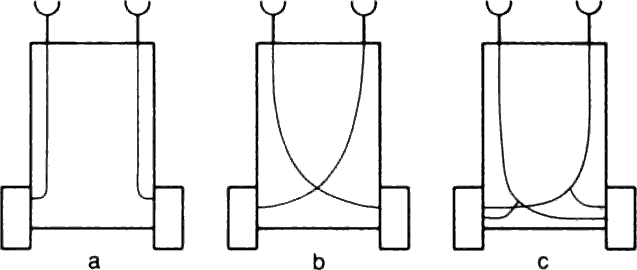
Valentino Braitenberg, Vehicles: Experiments in Synthetic Psychology.
In Vehicles, Valentino Braitenberg imagines a series of extremely simple machines.
A basic vehicle might contain:
- wheels
- motors
- light sensors
- connections between sensors and motors
Changing only the relationship between these components can produce very different behaviours.
A sensor might increase the speed of the motor on the same side.
Or it might control the opposite motor.
The vehicle may then appear to:
- approach a light
- avoid it
- chase it
- hesitate
- become aggressive
- appear curious
The mechanism remains simple.
What changes is how we interpret its behaviour.
Look for
- sensing
- response
- direct connections
- crossed connections
- attraction
- avoidance
- speed differences
- behaviour emerging from simple relationships
Questions
- How much information does the vehicle actually have?
- Does it know where it is going?
- Does it need an internal model of the environment?
- Why do we begin describing the behaviour with words such as “afraid” or “aggressive”?
- Is apparent intention the same as actual intention?
- How little complexity is required before we perceive agency?
This question will return later when working with AI systems.
Try this
Imagine an element with two values:
left sensor
right sensor
and two possible actions:
turn left
turn right
Invent different relationships between sensing and action.
For example:
object close on left → turn right
Then reverse the rule.
What kind of behaviour appears?
References
- MIT Press - Valentino Braitenberg, Vehicles: Experiments in Synthetic Psychology
- MIT Press - The Open Dynamics of Braitenberg Vehicles
Steering and response
A useful way to think about a simple agent is:
state
  ↓
sense
  ↓
decide
  ↓
act
  ↓
new state
The element does not need to be intelligent.
It only needs a relationship between its current situation and what happens next.
For example:
Attraction
target is to the right
↓
turn right
Repulsion
object is close
↓
move away
Boundary response
edge reached
↓
change direction
Following
another element is ahead
↓
move toward it
Wandering
occasionally change direction
These behaviours can be combined.
A system can therefore become more complex without introducing a completely new mechanism.
The complexity can come from several simple rules operating at the same time.
Craig Reynolds: Boids
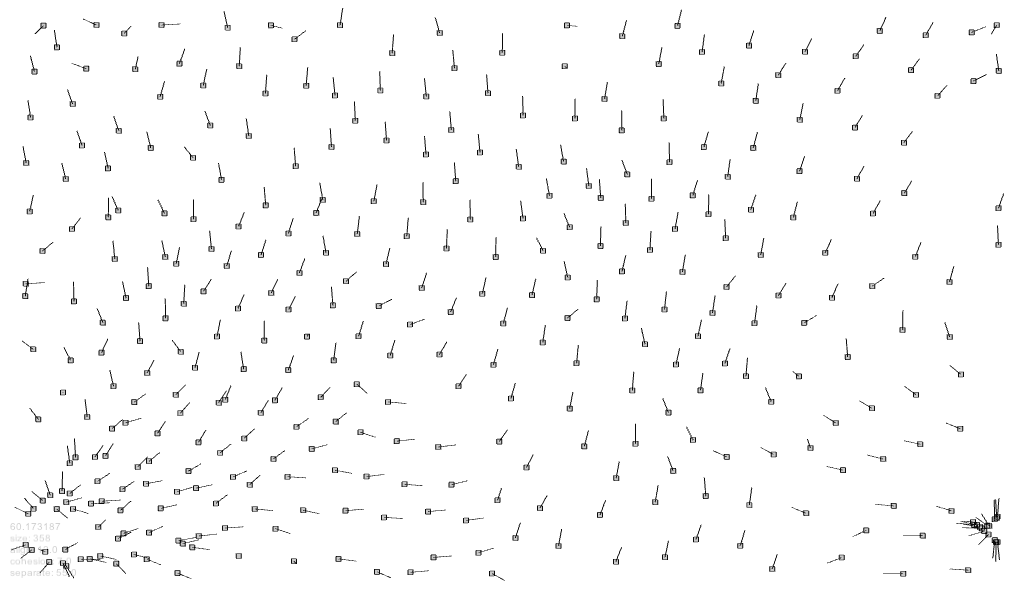
Craig Reynolds, Boids, 1986.
Craig Reynolds developed the Boids model to simulate coordinated group movement such as flocks of birds and schools of fish.
Instead of programming the path of every individual bird, each boid responds only to nearby neighbours.
The classic model uses three local steering behaviours.
Separation
Avoid crowding nearby neighbours.
too close → move away
Alignment
Move toward the average heading of nearby neighbours.
neighbours moving this way → turn toward that direction
Cohesion
Move toward the average position of nearby neighbours.
group is over there → move toward group
None of these rules describes a flock.
The flock appears when many agents follow the rules simultaneously.
The important relationship is:
local rules → interactions → global behaviour
Look for
- individual agents
- neighbourhoods
- local perception
- steering
- separation
- alignment
- cohesion
- collective movement
- emergent structure
Questions
- Where is the shape of the flock stored?
- Who controls the group?
- Does any individual boid know the final pattern?
- What happens if one rule is removed?
- How does the number of neighbours affect the system?
- Is the movement still predictable even if every rule is deterministic?
Try this
Do not begin by implementing the complete Boids algorithm.
Start with one relationship.
For example:
Several elements move independently. If two become too close, they move apart.
Observe the result.
Then add another rule.
They also gradually align their direction.
What changes?
The aim is to understand how several local relationships combine, not to copy a finished flocking implementation.
References
- Craig Reynolds - Boids: Background and Update
- Craig Reynolds - Flocks, Herds, and Schools: A Distributed Behavioral Model
- Craig Reynolds - Steering Behaviors
Conway’s Game of Life: behaviour without moving agents
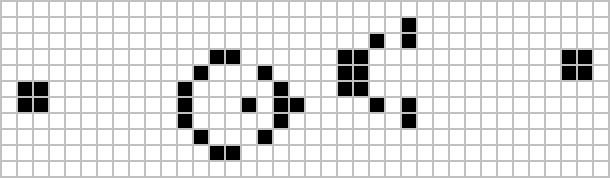
Conway’s Game of Life.
Conway’s Game of Life is a cellular automaton developed by mathematician John Conway in 1970.
The system consists of a grid of cells.
Each cell can be:
alive
or:
dead
A cell does not move.
Instead, its next state depends on the number of living neighbouring cells.
The standard rules can be summarised as:
- too few neighbours → a living cell dies
- two or three neighbours → a living cell survives
- too many neighbours → a living cell dies
- exactly three neighbours → a dead cell becomes alive
These local rules are applied repeatedly across the whole grid.
From them emerge:
- stable structures
- repeating oscillators
- moving patterns
- growth
- collapse
- highly complex long-term behaviour
Look for
- discrete states
- neighbourhoods
- local rules
- repeated updating
- patterns that persist
- patterns that oscillate
- patterns that appear to move
Questions
- Is a cell an agent?
- What information does one cell have?
- Can something appear to move even when no individual cell moves?
- Where does a glider’s movement come from?
- How can four simple rules create such a large space of possible outcomes?
- Is the behaviour contained in the rules or in the initial configuration?
Try this
Imagine a simpler version with only two rules.
For example:
if exactly one neighbour is active → activate
otherwise → deactivate
Draw several generations manually on graph paper.
What kind of behaviour appears?
The point is not to reproduce the Game of Life exactly.
The point is to see how local state changes can produce global dynamics.
References
- LifeWiki - Conway’s Game of Life
- LifeWiki - pattern collection and reference
- Wikipedia - Conway’s Game of Life
Feedback
A response becomes feedback when the result of an action changes what can happen next.
A simple response might be:
mouse moves
↓
circle follows
A feedback loop might be:
agent moves
↓
agent leaves a trail
↓
trail changes the environment
↓
agent senses the trail
↓
agent changes direction
↓
new trail
The system is now partly responding to its own history.
Feedback can produce:
- stabilisation
- oscillation
- acceleration
- collapse
- growth
- self-organisation
- unpredictable behaviour
Positive feedback
A change reinforces itself.
more agents
↓
more attraction
↓
more agents gather
↓
even more attraction
Negative feedback
A change reduces itself.
too dense
↓
agents move apart
↓
density decreases
Many interesting systems combine both.
Questions
- Does the environment change because of the system?
- Does that changed environment affect future behaviour?
- What information survives from one moment to the next?
- Does the feedback stabilise the system or amplify it?
Jean Tinguely: the machine has character
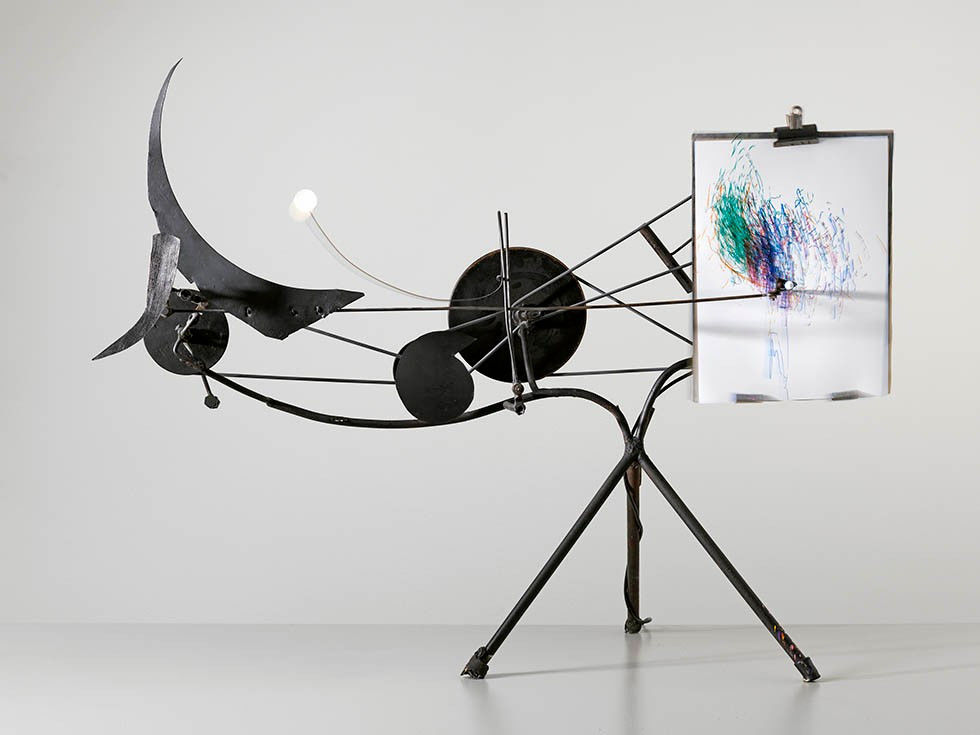
Jean Tinguely, Méta-Matic drawing machines, 1959.
Jean Tinguely’s Méta-Matics were machines that produced drawings.
But their importance is not simply that machines could draw.
Traditional machines are often associated with:
- precision
- repetition
- efficiency
- accuracy
- control
Tinguely’s machines introduced:
- vibration
- instability
- chance
- irregularity
- participation
- mechanical imperfection
The machine becomes expressive precisely because it does not behave like a perfect technical instrument.
Tinguely used the term Méta-Matic for machines that could themselves produce artworks.
This complicates the relationship between:
artist → machine → participant → drawing
Look for
- physical constraints
- mechanical wobble
- repetition with variation
- unpredictable traces
- participation
- limited control
- the personality of the mechanism
Questions
- Who makes the drawing?
- Is the machine a tool, a performer or a collaborator?
- What part of the result is controlled?
- What part comes from material or mechanical variation?
- Would a perfectly accurate version be more interesting?
- Can limitation give a system character?
Try this
Take a perfectly functional digital drawing tool.
Add one limitation.
For example:
- the cursor follows with a delay
- the line occasionally changes direction
- movement has inertia
- the tool refuses to draw in some areas
- speed changes the line unpredictably
- previous marks influence future movement
Do not add many effects.
Add one behavioural characteristic and see whether the tool begins to feel different.
References
Behaviour, trace and drawing
Movement can become visible when the system leaves a trace.
rule
↓
behaviour
↓
movement
↓
trace
↓
drawing
This produces an important shift.
Instead of designing:
What should the drawing look like?
design:
What should the system do?
The final image becomes evidence of the process that created it.
A trace can record:
- position
- speed
- direction
- collisions
- interactions
- errors
- repetition
- time
- memory
Two runs of the same behavioural system may therefore produce different drawings while still clearly belonging to the same family.
This is the connection to the drawing machine exercise.
Five ingredients of behaviour
When building or analysing a behavioural system, it can help to separate five ingredients.
1. State
What does the element currently know or remember?
For example:
position
velocity
direction
age
energy
previous state
State describes the current condition of the system.
2. Perception
What information can affect the element?
For example:
canvas boundary
mouse position
distance to another element
neighbouring cells
existing trail
sound
time
Perception does not need to be realistic sensing.
It simply means information available to the rule.
3. Rule
How is that information interpreted?
For example:
if distance < 50 → move away
or:
if edge reached → reverse velocity
The rule connects perception with action.
4. Action
What can the element change?
For example:
move
rotate
accelerate
stop
draw
change state
create another element
remove itself
5. Feedback
How do those actions affect future conditions?
For example:
draw trail
↓
trail changes environment
↓
future movement changes
These five ingredients do not need to appear equally in every system.
A very simple behaviour may only use a few.
From movement to behaviour
It can help to compare several levels of complexity.
Movement
x = x + 1
The value changes.
Response
if edge reached → reverse direction
The change depends on a condition.
Behaviour
move
↓
sense
↓
respond
↓
update
↓
repeat
Several relationships operate over time.
Collective behaviour
many agents
+
local relationships
↓
emergent global pattern
The larger structure is not explicitly drawn.
It emerges from interaction.
Things to investigate
When you encounter an agent-based, interactive or behavioural system, try to reverse-engineer it.
Ask:
- What is the smallest behaving element?
- What state does it store?
- What can it sense?
- What rules connect sensing to action?
- What changes every frame?
- What is deterministic?
- What is probabilistic?
- How does it respond to boundaries?
- Does it interact with other agents?
- Does it change its environment?
- Does the changed environment affect future behaviour?
- Is there feedback?
- Does it leave a trace?
- What global behaviour emerges from the local rules?
- Would changing one small rule produce a very different system?
- Why do we describe the behaviour as purposeful, expressive or intelligent?
The goal is not simply to create more complicated movement.
The goal is to understand how relationships between state, sensing, rules and feedback create behaviour.
→ Drawing machine references
→ Notes on this session
→ Back to Session 4